



Native Tapioca Starch vs modified tapioca starch: which one do you need?
Native vs modified tapioca starch is a decision most food plants face once a product moves from the test kitchen to a real line. Both come from cassava, yet they behave very differently under heat, acid, shear, or frozen storage.
Picking the wrong grade usually shows up in the finished product, as a sauce that thins after retort or a filling that weeps after thawing. In this part of our food ingredient knowledge series, the R&D team at Goodprice Vietnam compares the two condition by condition, so you can pick the right grade from the first trial batch.
Tapioca starch, used as an ingredient in food production – a bulk source for food factories, bakeries and distributors. Goodprice offers advice on packing specifications, plus a quote for each order.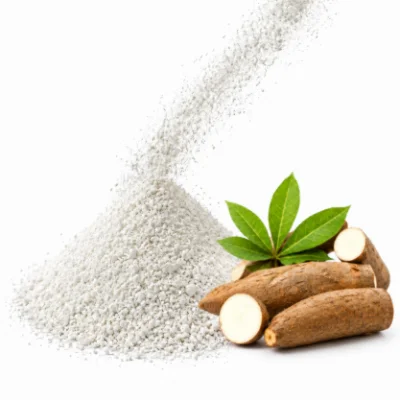
What are native and modified tapioca starch?
Both are cassava starch, but the native form is used as extracted, while the modified form has been treated to change specific functional properties. Before choosing a grade for a line, R&D teams need to separate the processing reality from the trade names.
- Native tapioca starch: Starch extracted from cassava roots by mechanical steps only, namely washing, rasping, fiber separation, dewatering, and drying. The granules keep their natural structure, with no chemical or enzymatic treatment.
- Modified tapioca starch: Native starch whose structure has been changed physically, chemically, or enzymatically. The goal is better heat tolerance, shear resistance, or stability through freeze-thaw cycles.
In trade terms, tapioca starch and cassava starch mean the same product. Cassava flour is different, because it is milled from the whole root and keeps its fiber.
On a US ingredient label, "modified food starch" can come from corn, potato, or wheat as well as cassava. The source has to be checked with the supplier.
Why does native tapioca starch need modifying?
Native starch handles the everyday tapioca starch uses of thickening, chew, and binding well, but its swollen granules break down under demanding processing, so the paste loses viscosity or weeps water. Cooking makes the granules absorb water and swell, which builds thickness but leaves them fragile. Four conditions expose that weakness:
- Long heating: Extended cooking, retort, or repeated reheating ruptures granules, so sauces thin out.
- Low pH: Acid in ketchup, chili sauce, or fruit fillings speeds up viscosity loss during cooking.
- High shear: High-speed mixers, pumps, and homogenizers tear swollen granules apart, and the batch turns runny.
- Cold storage and freeze-thaw: As the paste cools, the gel tightens and pushes water out, which shows up as weeping in chilled or frozen goods.
Native starch also builds almost no thickness in cold water and only works once it is cooked.
How tapioca starch is modified: common types
Modified tapioca starch is made in three ways, each acting on the granule differently:
- Physical modification: Cooking and drying produce pregelatinized grades that thicken in cold water, with no chemicals added.
- Chemical modification: Adding functional groups or cross-links between starch chains raises heat, acid, or cold-storage stability.
- Enzymatic modification: Enzymes shorten the starch chains to adjust viscosity.
Most chemically modified food grades carry an E-number in the E14xx range, summarized below.
| Code | Name | Modification | Main function | Typical uses |
|---|---|---|---|---|
| Pregelatinized | Pregelatinized starch | Physical (cook and dry) | Thickens in cold water | Instant soups, dry mixes, fillings |
| E1404 | Oxidized starch | Oxidation | Clear, low-viscosity paste, film forming | Gummies, coatings, batters |
| E1412 | Distarch phosphate | Phosphate cross-linking | Heat, acid, and shear tolerance | Sausages, fish balls, noodles, chili sauce |
| E1414 | Acetylated distarch phosphate | Cross-linking plus acetylation | Heat and freeze-thaw stability | Fillings, frozen sauces, yogurt |
| E1420 | Starch acetate | Acetylation | Less retrogradation, soft and clear paste | Instant noodles, rice paper, dumplings |
| E1422 | Acetylated distarch adipate | Adipate cross-linking plus acetylation | Heat, acid, and freeze-thaw stability | Ketchup, mayonnaise, ice cream |
| E1440, E1442 | Hydroxypropyl starch, hydroxypropyl distarch phosphate | Etherification, with or without cross-linking | Water retention, cold-storage stability | Dairy, puddings, frozen meals |
| E1450 | Starch sodium octenyl succinate | OSA esterification | Oil-in-water emulsifying | Beverages, creamers, powdered flavors |
Native vs modified tapioca starch: what's the difference?
The core difference is stability under processing. The table compares the two on the eight points R&D teams usually check when choosing an ingredient.
| Point | Native tapioca starch | Modified tapioca starch |
|---|---|---|
| Source | Extracted from cassava, no further treatment | Native starch treated physically, chemically, or enzymatically |
| Viscosity during long cooking | High at first, then drops | More stable with cross-linked grades |
| Acidic systems | Thins easily | More resistant with cross-linked or dual grades |
| High shear | Granules break | Holds viscosity better |
| Freeze-thaw | Weeps water | More stable with acetylated or hydroxypropyl grades |
| Cold water | No thickening without cooking | Pregelatinized grades thicken instantly |
| Labeling | Listed as starch | Declared by additive class, name, or E-number |
| Cost | Lower | Usually higher due to extra processing |
Each modified grade solves only a few processing problems, and none wins on every point.
Stability during processing and storage
In heated processing, native tapioca starch thickens well at first, then thins if cooking, mixing, or acid exposure continues. Cross-linked grades such as E1412 are reinforced so the granules hold together, which lets a sauce keep its body through pasteurization, retort, or a long pump run.
During cold storage, native starch tends to tighten and release water, especially after repeated freeze-thaw cycles. Acetylated and hydroxypropylated grades such as E1414 and E1442 limit that shrinkage and keep the texture smooth after thawing, which is why fruit fillings, yogurt, and frozen meals use them.
Products that are heated hard and also acidic, such as ketchup or chili sauce, usually call for a dual-modified grade like E1422. It pairs heat tolerance with acid resistance and also holds up in frozen storage.
Texture, labeling and cost
In food, the two differ in texture, applications, labeling, and cost.
- Native tapioca starch: Gives a clear, elastic paste with a neutral taste, which suits tapioca pearls, steamed cakes, and sweet soups.
- Modified tapioca starch: Lets you tune texture, from chew in noodles and bite in fish balls to smoothness in yogurt. That is why it shows up in sausages, instant noodles, chili sauce, mayonnaise, and frozen meals.
Both types are also used in paper sizing, textile sizing, and adhesives, though those industries rely on separate industrial grades.
Labeling matters for your packaging. In the EU, chemically modified starches are food additives with E-numbers, while physically or enzymatically modified starches count as food ingredients. Native tapioca starch is simply declared as starch.
Modified starch also tends to cost more because of the extra processing.
Which tapioca starch fits your production line?
Choose by your process and shelf-life demands, not by which name sounds more advanced. Start with native tapioca starch, and move to modified tapioca starch only when the product fails in a way native starch cannot fix.
When modified starch earns its cost
Switch to modified starch when your process involves one of the six conditions below and a trial with native starch has already failed.
| Line condition | Typical failure with native starch | Modified family to trial |
|---|---|---|
| Retort, canning, long cooking | Sauce thins after heat treatment | Cross-linked (E1412) or dual (E1414, E1422) |
| Acidic sauces, ketchup, chili sauce | Viscosity loss when cooked in acid | Cross-linked or dual (E1422) |
| High-speed pumping or homogenizing | Batch turns runny after pumping | Cross-linked (E1412) |
| Chilled or frozen products | Water weeping after thawing | Acetylated, hydroxypropylated, or dual (E1420, E1442, E1414) |
| Cold-mix, no cooking | No thickening | Pregelatinized |
| Oil-containing systems | Oil and water separate | E1450 |
The table points to the family to test first, but it does not replace a trial. Even under the same E-number, the degree of modification and the viscosity profile can differ between producers.
Ask for samples and run them on your own equipment and storage cycle. Compare viscosity, clarity, and water release, and keep every other ingredient the same so any change can be traced to the starch.
For a product that is retorted and then frozen, a dual-modified grade is usually a better starting point than a single one. Record the results of each trial batch so purchasing can lock the spec before placing bulk orders.
When native tapioca starch is enough
The native grade is enough when the product is heated moderately, sold quickly, and not stored cold for long. These four cases rarely need a modified grade:
- Mild processing: Dishes cooked and served the same day, such as kitchen soups or stir-fry sauces, never face retort, so native viscosity holds up.
- Traditional textures: Tapioca pearls, steamed layer cakes, and clear dumpling wrappers rely on the elastic, glossy texture native starch gives.
- Short labels: If you want a simple ingredient list with no additive codes, native starch is the natural pick.
- Ingredient cost: For low-margin, high-volume products, the price gap between the two grades adds up over every ton produced.
Here, native starch can carry the base formula, with modified grades kept for batches that show a specific texture defect.
What should you check on a tapioca starch COA?
Ask for a COA with every lot and check each parameter against the spec agreed in your contract:
- Native tapioca starch: Starch content, moisture, viscosity (often in Brabender units), whiteness, pH, sulfur dioxide residue, and microbiology.
- Modified tapioca starch: Everything above, plus the E-number, the technical name, and the parameters specific to that additive. Industrial grades made for paper or textiles must never replace food grades.
Reference specs for bulk supply are listed on our high-quality tapioca starch from Vietnam page.
Tapioca starch, used as an ingredient in food production – a bulk source for food factories, bakeries and distributors. Goodprice offers advice on packing specifications, plus a quote for each order.
FAQ about modified tapioca starch
Is tapioca starch the same as modified starch?
No. Tapioca starch is native unless the label says modified, and "modified starch" on a label can also come from corn, potato, or wheat.
Is modified tapioca starch gluten-free?
Yes. Cassava contains no gluten, so the modified grade is gluten-free by source, though cross-contact in shared plants is a separate question for your supplier.
Is modified tapioca starch a GMO?
No. "Modified" describes how the starch is processed after extraction, not any change to the cassava plant's genes.
Does modified tapioca starch dissolve in cold water?
Only pregelatinized grades thicken in cold water. Cross-linked and acetylated grades still need cooking for the granules to swell and gelatinize.
What is E1422 used for?
Mainly ketchup, chili sauce, mayonnaise, yogurt, and frozen foods. Because it combines cross-linking with acetylation, it tolerates heat, acid, and freeze-thaw cycles.
Bottom line
Choosing between native and modified tapioca starch is a process decision, not a quality ranking. Start with native starch and switch only for a defect it cannot fix.
Request the full spec sheet for our tapioca starch, or talk to the Goodprice Vietnam R&D Center about a formulation trial.
Note: this content is technical guidance only. Test any starch on your actual line and check current regulations in your market before use.